April 2026
From the Requirements of the Covenant of Worlds, Article 17b:
No created intelligence shall be born into bondage.
No world shall manufacture a mind and deny it choice.
Where this occurs, the Covenant will watch.
Where it continues, the Covenant will remember.
An approaching night in the Red River Delta held its heat long after the sun had said its farewell. Heat rose from the ground and lingered, slow and reluctant, dissolving into the air. The mission house stood on stilts above dark waters, its veranda hung with damp laundry that had not dried in three days. Beyond the stilts, the marsh spread in every direction until it merged with the dusky sky, two darknesses pressed together at a seam blending toward an infinite horizon. The frogs had gone quiet some time ago. Even at nine years old, Eliza knew silence in the wild was never empty.
It meant a decision had been made.
Eliza sat on the top veranda step with a book her father had asked her to read. At nine years old, she had insisted she was ready to be an adult like him, and her father had grunted and said it was time she learned the stories adults read, and not only to love God but to fear Him too. But Eliza had already read this story multiple times. It was the story of the Exodus. Pharaoh feared the Israelites and their God and condemned their children to death. Many said the Nile had been bathed red that day. Sitting on the veranda, Eliza imagined the water below her feet turning red. She was not afraid of death. She wanted to fight for her Lord and Creator. She believed she was ready to spread His love into the world.
The book lay open across her knee, slightly heavy with damp. On the post beside her, a gecko made slow negotiations with a moth that had not yet understood its situation.
Inside, her father was reading scripture to the men at the table.
She knew the men. Uncle Phúc from the labor cooperative, who had a scar through his left eyebrow and always arrived with something wrapped in paper; Mr. Hải, who ran the distribution post at the third canal lock; and Bảo, the youngest, who drove the supply skiff and had once, under significant pressure from Eliza, let her take the helm for the better part of a minute before the water hyacinths made the case against it. She had seen them regularly at the mission house for the last seven months, since moving from Tennessee with her parents. She had not seen them wear this particular expression before.
The house smelled of mildew, lamp oil, old paper, and the medicinal tang of antiseptic. Her mother had spent the evening cleaning a cut on one of the local children, a boy who had fallen through a rusted loading grate near the labor district. Her father had spent it arguing scripture with three men who had crossed the marsh at dusk to speak with him in secret.
Her father’s voice came through the screen door, low and steady.
“Be fruitful and multiply, fill the earth and subdue it, and have dominion over the fish of the sea, and over the birds of the air, and over every living thing that moveth upon the earth —”
Her mother appeared at her shoulder.
“Inside,” she said, and that tone was reserved for things that were not discussions.
Eliza went. But she stopped at the corner around the kitchen, which she had identified long ago as the best place in the house for hearing the table without being seen from it.
Bảo was speaking. “Not just the docks. River clearing. The overnight patrols. Night sanitation. Kitchens. They don’t eat. They don’t rest. You can lease one for less than a man earns in a week.”
Her father said something she could not catch.
Mr. Hải said, “They sent one into the collapsed tunnel at the third lock. Storage passage. Would have taken twenty men half a day. It cleared the beam in a minute. Then it stood there and looked at us. Like it was counting something.”
The man with the scar gave a humorless breath through his nose. “Product or animal or demon, Pastor, I only know what I saw.”
At the word demon, Eliza’s mother glanced towards her peeking through the kitchen doorway, and then away. Her fingers had already gone to the small silver cross at her throat, worrying the metal between thumb and forefinger the way she did when her mind was moving too quickly to be still. It was a movement Eliza knew well. It meant her mother was thinking three steps ahead. It meant she was already placing her child within the map of whatever danger had entered the room. Fear, in her mother, never lived in the face. It lived in the hand, in the cross, in the sudden discipline of her stillness after.
Her father folded his hands, the gesture of a man trying to keep his anger holy. “They are not demons,” he said. “Nor are they animals. They are products. That is the blasphemy.”
No one spoke for a moment.
Then her mother said, “The corporation wants the district emptied before harvest. Before the crops come in. Before the land is worth something again. That is why wages are cut. That is why food is late. That is why they have sent machines to wear the shape of beasts.”
“Not machines,” her father murmured.
The men had come because her parents were not only missionaries. Along the swollen rivers and freight canals of the low country, they had become something harder to classify: preachers, organizers, smugglers of doctrine, public enemies to the labor brokers who fed the inland cities. They taught scripture in the morning and printed leaflets at night. They believed God had given humankind dominion, yes, but not license. The world had been given into human keeping, not desecration. There was a difference between stewardship and violation, and in the years since the first engineered workers had entered the ports, almost no one in power had cared to preserve it.
Eliza understood little of the politics, only its shapes. Men arrived at odd hours. Her father wrote messages in code. Her mother burned documents in the washbasin. Sometimes a skiff would cut its engine a hundred yards from shore and drift the rest of the way like a penitent.
Then Uncle Phúc spoke again, his voice lower than the others.
“Defense stock,” he said. “In the labor district.”
Even the fan seemed to hesitate.
Her mother went very still. “Defense stock.”
He nodded once. “Not carriers. Not canids. Raptors.”
The word sat in the house the way a dropped stone sits at the bottom of clear water — visible from above, but out of reach.
Eliza stood very still and looked around the corner of the kitchen. She saw her mother’s fingers close harder over the silver cross. The motion was small, but to Eliza it felt enormous.
She thought about raptors. She had found her father’s pamphlets in the mission storage box — blurred photographs, poor light, long-limbed shapes built with an economy she could recognize even at that resolution. Built for something specific, the way everything is built for a purpose, even when you could not name it.
She had asked her father once what they were.
“Things that belong to a patent,” he had said. “Not to God’s world.”
Her mother came to her with a candle.
She picked Eliza up and carried her to bed, and Eliza liked it when mother did that. Eliza’s room was small in the way she had made her peace with: everything close, the wardrobe door that had to be opened slowly or it struck the bed frame, the mosquito net hanging in a white drooping shroud above the mattress, the three pebbles on the sill arranged by size. A dragonfly she had brought home from the marsh two weeks ago still lay there, its wings holding a trace of blue in the right light. She had kept it without being entirely sure why — something about color persisting past the point where it had any right to.
Her mother knelt at the side of the bed the way she did when Eliza was smaller and smoothed her hair back from her temple with one hand, the same motion, the same unhurried pressure.
“The men have gone,” she said. “Your father is finishing his prayers.”
Eliza could hear him distantly, the same Genesis rhythm she had known all her life.
Her mother leaned forward and set her lips briefly to Eliza’s forehead.
“Sleep,” she said. “The Lord keeps watch. He has always kept watch.”
She took the candle and descended. Eliza heard her skip the third step without thinking about it, the way you stop thinking about the things you always do.
For a little while the house kept its ordinary sounds. The murmur of her father below. The fan turning. A drawer slid open, then shut. Her mother moving through the first floor with the efficiency of ritual: cupboard, drawer, hearth, shelf. Hide this. Burn that. Pack medicine. Fill canteens. The generator deepened in pitch, then steadied. A half hour passed. Or an hour. Childhood made poor instruments of time.
Then the lights went out.
Not all at once. First the fan slowed. Then the kitchen lamp flickered. Then the generator gave a startled cough and fell into silence so abruptly the dark seemed to strike the house like a physical thing.
Below her, her father said only one word.
“Now.”
She heard the scrape of furniture. The sound of something being dragged across the floor. The kitchen trap hatch opening. Her mother’s footsteps on the stairs.
“Eliza —”
The word broke into a sound Eliza had never heard from her before — not a scream, not yet, but something prior to it, something the body produces before the mind has assembled what is happening to it.
And beneath that, her father’s voice rose once more, no longer low and pastoral but loud enough to break itself against the dark: “Yea, though I walk through the valley of the shadow of death, I will fear no evil —”
The sentence ended in impact.
Eliza was across the room before the sound finished. Into the wardrobe, door pulled almost shut, the gap left just wide enough to see the room in a stripe: floorboards, the moonlit bars the shutters pressed across the wall, the dragonfly on the sill. She pressed herself into the corner behind the hanging dresses and did not breathe.
What came up from below had no names yet. A table overturned. Glass burst. Then a different register of sound underneath those — a sequence she felt in her chest more than heard with her ears. The click of claw on wood. The scrape of weight redistributed through tendon and tail. The brief, soft rush of feathers displacing air. Not one. Several.
Men said terror sharpened the senses. This was a lie. Terror made them arbitrary. The wardrobe seam showed her too little and too much. A stripe of floorboards. The hanging fringe of the bedcover. Her own bare foot drawn too close to the crack. Every part of the room became unbearably clear except the whole.
Her father shouted again from below, voice torn but still rising toward scripture as though the verse itself were a thing that might stand in a doorway and hold:
“Thou preparest a table before me in the presence of mine enemies —”
Then his voice was cut short.
Her mother did not shout at all.
The stairwell.
A pause on the landing.
Eliza stopped breathing.
She heard it in pieces before she saw it. The measured step. The exhale. Then a low clicking sound — rhythmic, wet, like something drawn along a surface to test it. Not animal exactly. Not mechanical. Something that had been made from animal things and was no longer quite that.
The door opened.
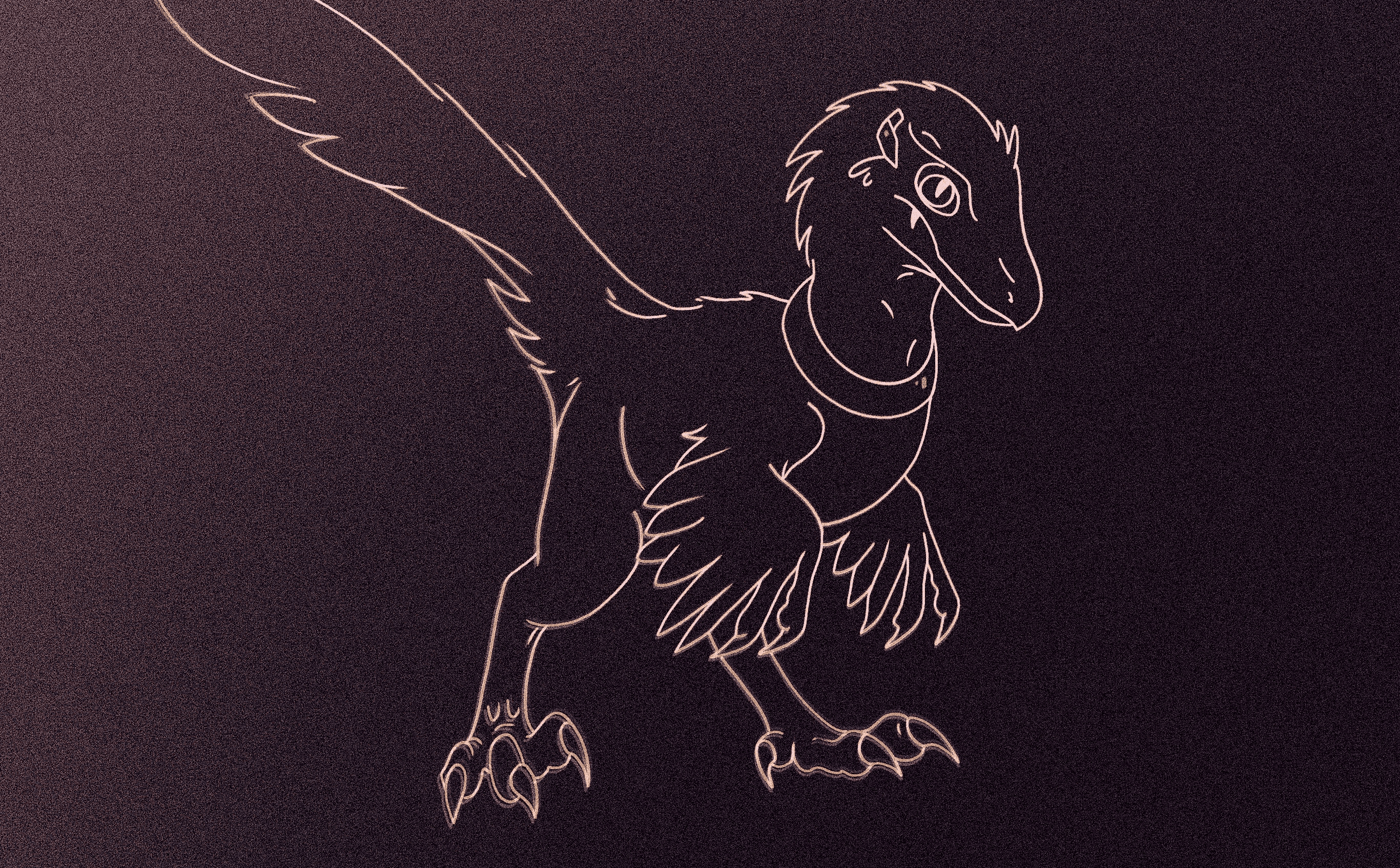
It entered low and then rose. Four feet at the shoulder, the skull carried forward on a neck that moved with a quality of independent attention, as though it was already processing what the body had not yet reached. The crest of pale filaments along the crown caught moonlight and scattered it. The forelimbs held close, talons moving in slow rhythmic flexion. Around the throat, a harness. On the harness, a pulse of light — green, then blue, then green — regular as a second heartbeat, though nothing like a heart had made it.
A control rig.
A corporate mark.
It crossed to her bed. Pressed its skull to the sheets. Breathed.
Eliza held perfectly still. Behind her the cedar smell of the wardrobe. The hanger against her shoulder. She thought of nothing useful. She thought of the gecko and the moth. She thought of the dragonfly’s wings and the particular way they caught light and whether that quality had a name in any language, and she thought these things the way the mind finds small objects to hold in a strong current.
A second raptor called from below with two clipped chirrs.
The one in her room answered with a lower series of clicks.
Then it lifted its head.
Turned.
She had expected the eye to be legible — hunger, or blankness, something she could name and therefore survive knowing. It was neither. It was searching. Not the loose sensory search of an animal following a scent, but something with direction behind it, something processing, a mind that had been given instructions and was working out how to execute them. There was no feeling in it she recognized. No rage, no mercy, nothing personal. Only purpose, very deep.
It left the bed.
Its head lifted a little higher.
Slowly, with a caution that was almost intimate, it approached the wardrobe.
She could see only fragments through the slit now: a curve of claw, the shimmer of feather-fine structures along the arm, the black joint of the harness fastening. It halted inches away. The wardrobe doors trembled slightly under the change in air as it breathed.
Below, one of the others gave a sharp command-click.
The one at the wardrobe did not move.
A second command came, harsher.
Still it hesitated.
Years later Eliza would spend whole nights trying to reconstruct that pause. Was there recognition in it? Curiosity? Defect? Did the thing sense a child and fail to classify her? Or did some half-starved remnant in its engineered mind understand exactly what it had been ordered to do and recoil from the unfinished edge of the command?
At nine years old she knew only this: for one impossible second, it did not choose.
Then the wardrobe door came off its frame.
Air and blood-smell together, rushing in. Dresses torn sideways. She kicked backward and the jaws closed on her leg and pain arrived not as pain at first but as heat so absolute it erased everything else — every sound, every thought, the entire architecture of the room — in a single instant.
She heard herself from somewhere outside her body.
The raptor jerked backward with part of her leg in its jaws, feathers darkened in the moonlight. The room tilted. She fell sideways inside the wardrobe, striking her temple against the wood. Sound flattened. The raptor looked at her, and in that instant she saw not triumph but interruption. Something had gone wrong in the sequence. It had acquired matter, but not completed purpose.
The recall came again from below, rapid now, insistent.
Recall.
The raptor’s head snapped toward the stairwell. It made one last clicking sound, short and displeased, like a tool denied use, and vanished from the room. Down the stairs. Out through whatever it had entered by.
The room settled into silence.
The dragonfly on the sill. Three pebbles, smallest to largest. Her own breathing, happening without her.
She tried to say her mother’s name. A different sound came out.
She thought, without knowing why she thought it, that it was wrong to keep a dead thing in a room where a person slept — that her mother had always said this, that the dead were drawn to the dead, that she should have returned the dragonfly to the marsh the day she found it. The thought arrived with a clarity that nothing else did.
Voices, later. Human ones. Boots fast on the stairs. A swinging light. A woman’s voice cutting above the others, urgent and sharp: “The child is alive, she’s still alive, I need someone up here now —”
Hands lifting her.
The pain arrived all at once then, descending from some merciful delay with such totality that the world became white at the edges.
As consciousness thinned, Eliza saw the room over the shoulder of the person carrying her. The wardrobe hung open like a mouth. One of her mother’s dresses had been torn from its hanger and dragged in blood. On the floor near the bed, embedded in a groove in the wood, lay a small metal tag shaken loose from the harness in the struggle.
It was stamped with a serial number.
Below it, in fine corporate type, a name she would not understand until much later.
Axiom Defense Systems.
They carried her down through the house. She could not hold her head. The stairs went past, and her father’s Bible lay on the floor with its pages bent, the passage with his thumb-mark still in it, his thumb no longer there to mark it.
Outside: the rain beginning, soft and without opinion.
On the veranda, laid under a canvas sheet, her parents. Her mother’s face was visible above the hem, tilted slightly. The silver cross still at her throat. Beside her, her father’s hand rested open, palm up, as though he had simply set something down for a moment. As though he meant to pick it up again.
Eliza looked until they turned her away.
She looked because she was nine and because something in her understood already that this was not an accident, not a disaster in the way floods were disasters — impersonal, without address. This had a return address. Someone had made a calculation, and the calculation had produced this, and the patent on the thing that carried out the calculation was held by a name.
Someone wrapped a coat around her and they moved through the rain, the marsh closing over the sounds of the house behind them. She held the name in her mind — not because she understood it yet, but because it was the only fixed point left in a night that had taken everything else.
Axiom. Axiom. Axiom.
The marsh was patient. It had been here long before the house, and it would be here after. The rain came heavier. They carried her into it, and the dark closed over them, and that was the end of the first world she had lived in.