Oracle INC
At Oracle, I design customer-facing experiences that translate complex energy data into clear, motivating insights for millions of utility customers.
Manager
Karina Van Schaardenburg
Role
Product Designer II
Year
Aug 2022 - Current
PROJECT OVERVIEW
Product Manager
Alex Zhou
Project Role
Lead Product Designer
Timeline
6 weeks
PROBLEM STATEMENT
BDR and PTR programs depend on repeated customer participation across many peak events over time. However, the existing main-insight that showed user performance relied heavily on rank-based comparisons that many customers misunderstood, perceived as unfair, or found demotivating.
When customers could not clearly understand why they performed a certain way or whether their effort meaningfully mattered: trust eroded and motivation to participate in future events declined. This risked undermining both behavioral programs (BDR) and incentive-based programs (PTR), despite their different reward models.
The challenge was to redesign performance feedback to feel fair, transparent, and motivating while operating within real-world data constraints and scaling across millions of customers.
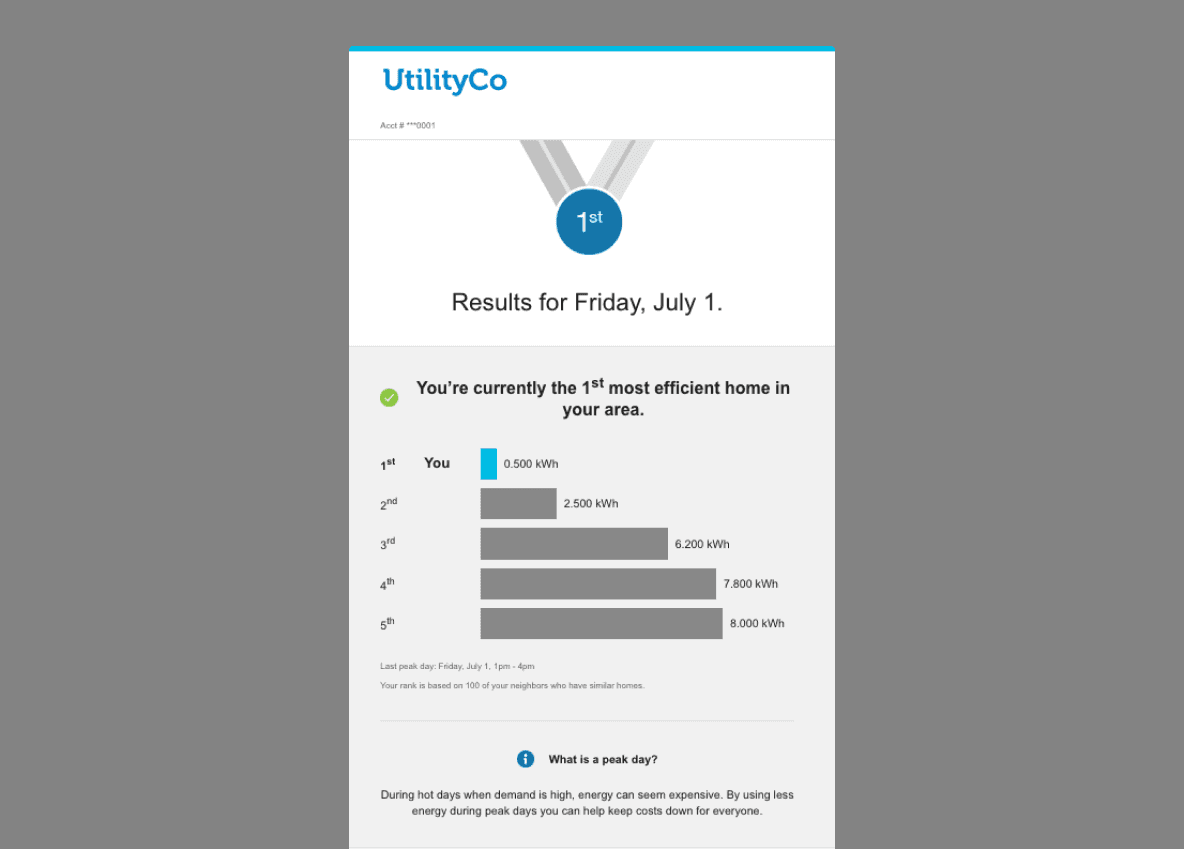
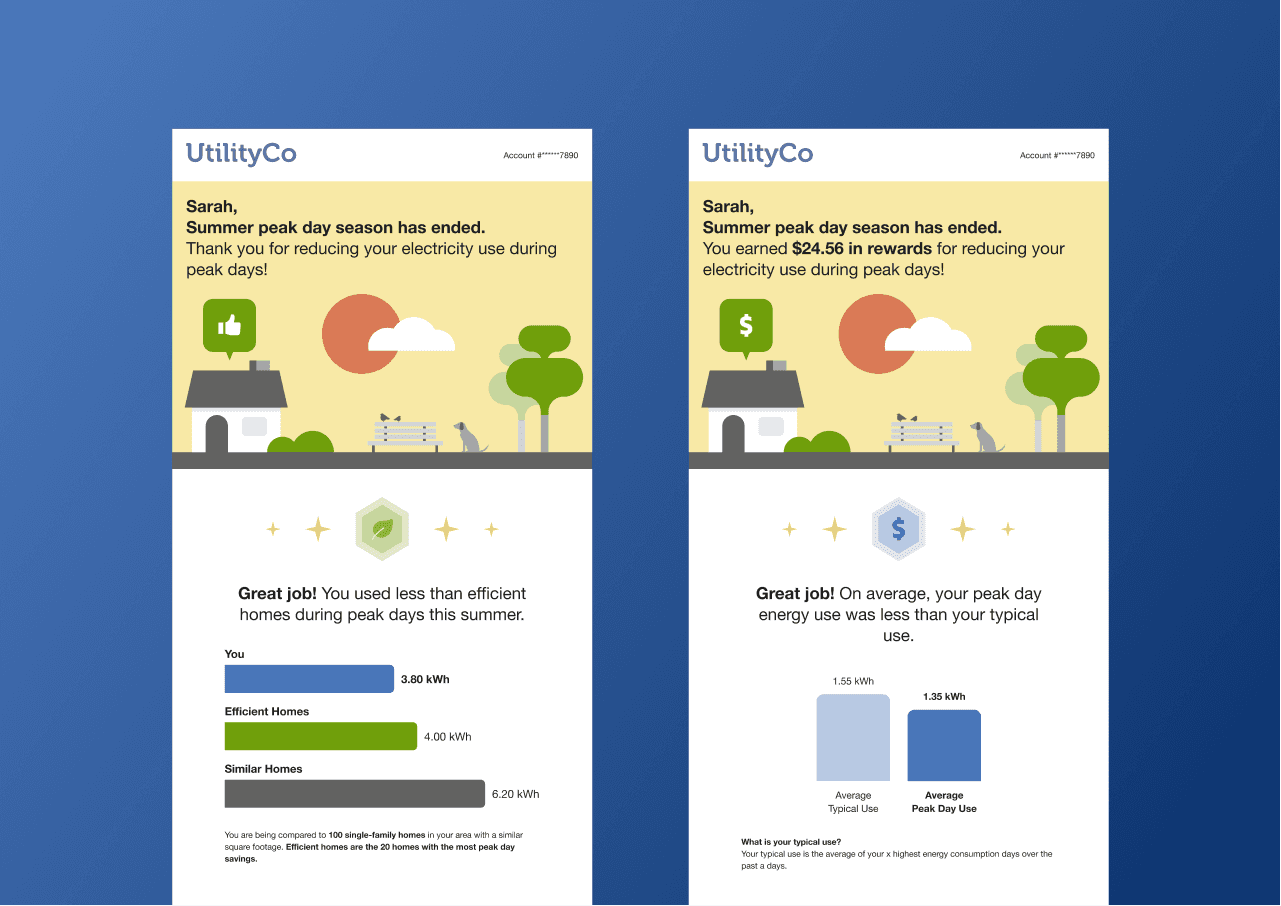
The BDR & PTR emails emphasized rank-based outcomes without sufficient context, explanation, or acknowledgment of effort. While these comparisons were technically accurate, they often failed to reflect real-world factors influencing energy use and left many customers uncertain about what their performance actually meant.
In parallel, the email experience had not evolved alongside newer design systems or behavioral science guidance, making it harder to clearly communicate intent, reinforce trust, or motivate continued participation at scale.
RESEARCH SYNTHESIS
Across both BDR & PTR emails, customers struggled not with performance itself, but with understanding what their results meant and whether their effort was recognized. This insight builds on foundational UX research conducted by Kate Roberts, which I synthesized and applied to the redesign.
misinterpreted rank-based comparisons as arbitrary
of customers lacked motivation without understanding impact
customers wanted stronger recognition for reducing use
These findings pointed to a need to move beyond ranking outcomes and toward feedback that clearly explained effort, context, and impact.
EXPLORATIONS
Guided by prior research, we explored a wide range of ways to frame the post-event “main insight,” iterating through multiple rounds of concepting across different performance lenses.
From these explorations, we narrowed to three distinct framing strategies that best represented the tradeoffs we wanted to test. Each variation embodied a clear hypothesis about how customers interpret performance, effort, and comparison — and was selected for quantitative validation.
Variation A — 3 Bar Comparison
HYPOTHESIS
Showing energy use alongside efficient benchmarks would encourage improvement without relying on rank. This approach was inspired by the 3-bar comparison, a proven main insight already used in our most successful product line, the Home Energy Report (HER).
Variation B — Relative Rank
HYPOTHESIS
An improved rank-based comparison could preserve competitive motivation while reducing confusion through clearer context and localized benchmarks.
Variation C — Population Context Grid
HYPOTHESIS
Visualizing performance within a broader distribution would help customers understand relative impact without invoking shame or loss framing.
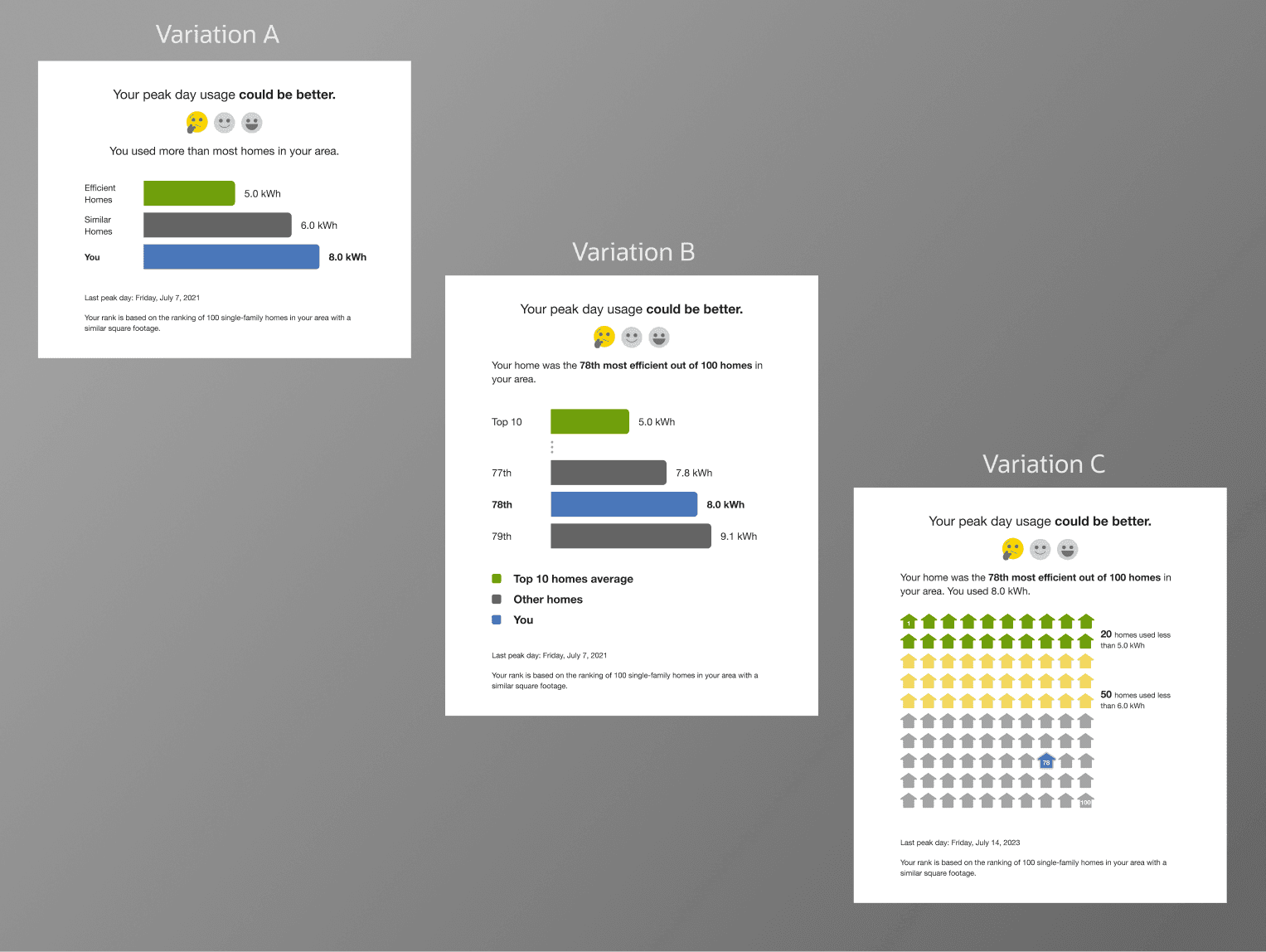
Together, these explorations revealed clear tradeoffs between competitive motivation, interpretability, and perceived fairness.
While some approaches improved clarity at the cost of motivation, others preserved motivation but continued to confuse users. These tradeoffs shaped which direction we moved forward to validate quantitatively. Some approaches improved clarity, they risked reducing motivation; others preserved motivation but continued to confuse users. These learnings directly informed which direction we validated quantitatively next.
VALIDATION
To avoid optimizing for novelty, we validated the leading concepts against the existing rank-based control. Variants were evaluated via controlled A/B tests across live post-event emails, measuring downstream energy savings, perceived clarity, and intent to participate in future events.
While an updated rank-based comparison performed better than the legacy version, it continued to introduce confusion around why performance differed. In contrast, the 3-Bar Comparison consistently improved interpretability without reducing motivation.
Decision
Adopt the 3-Bar Comparison as the primary BDR/PTR main insight
Extend the chosen direction with recognition, impact framing, and seasonal feedback
This decision balanced behavioral effectiveness with clarity, trust, and scalability across millions of customers.
BEHAVIORAL INCENTIVE
Peak-day programs are not just about reporting results, they are behavioral systems.
Across BDR and PTR, I designed two distinct reinforcement architectures based on program economics, client sensitivity, and behavioral science principles. While both products use comparative feedback, their motivational strategies differ intentionally.
BDR required performance-sensitive social reinforcement.
PTR required earnings validation without social pressure.
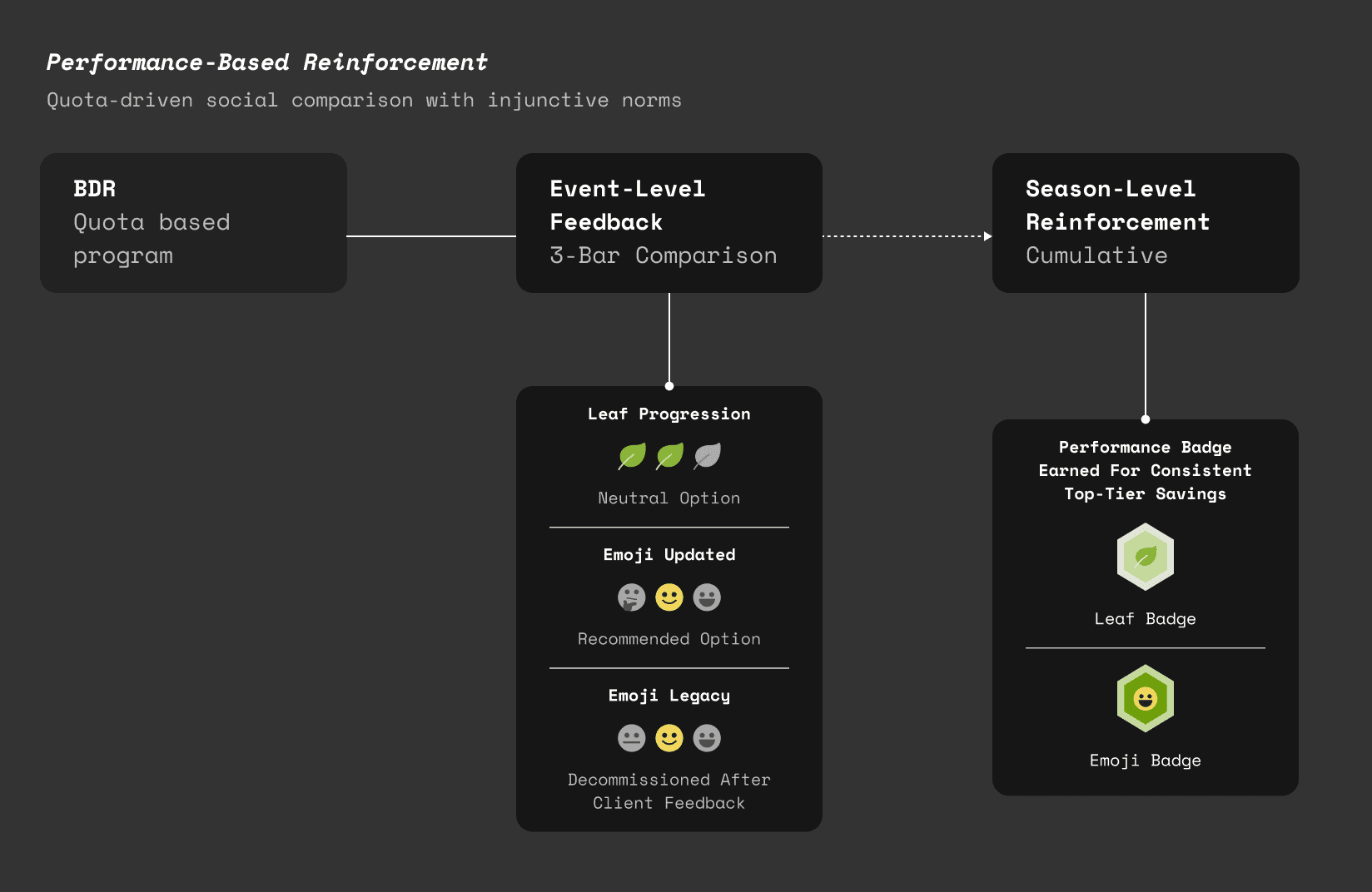
Quota-driven social comparison with injunctive norms
BDR is a quota-based program. Utilities only receive payment when customers collectively meet performance thresholds. Because savings outcomes directly impact revenue, the feedback system needed to reliably activate behavioral change.
To drive stronger response, I introduced tiered injunctive norms layered onto the 3-Bar Comparison model. Event-level feedback used graded performance signals (e.g., emoji or leaf progression) to communicate relative standing, while season-level reinforcement rewarded consistent top-tier savings with a performance badge.
However, social signaling required calibration.
Some utilities reacted negatively to the legacy emoji-based norm, citing customer complaints about perceived judgment. To address this, I:
Redesigned the lowest emoji state to feel reflective rather than punitive
Introduced neutral alternatives (leaf progression and geometric badges)
Allowed client-level flexibility while preserving behavioral intent
This resulted in a scalable norm system that balanced:
Behavioral effectiveness
Client comfort
Emotional tone
Program economics
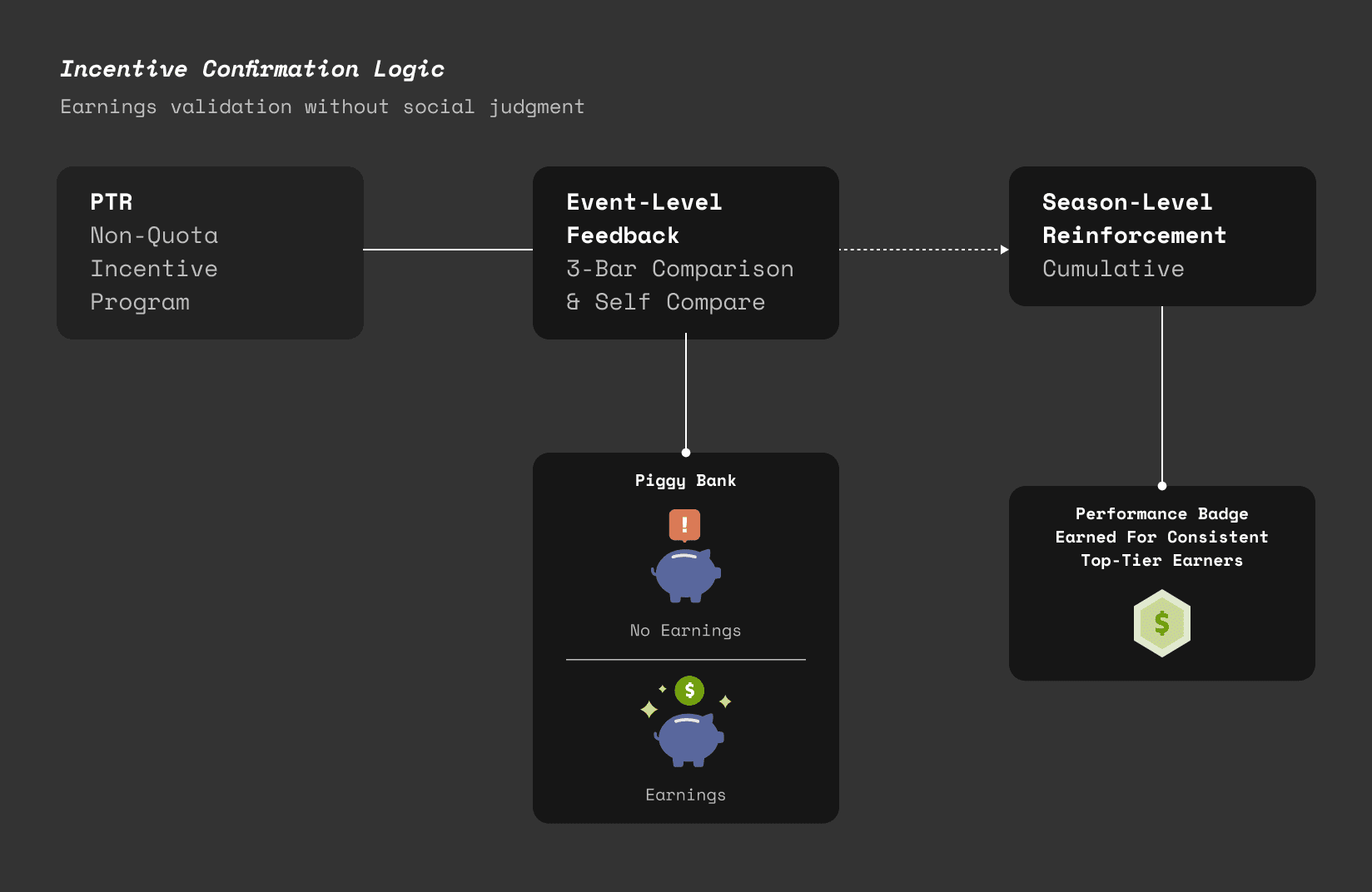
Earnings validation without social judgment
PTR operates differently compared to BDR.
It is not quota-based, and utilities do not rely on comparative savings performance to trigger payment. In this context, injunctive norms risked introducing unnecessary social pressure.
Instead of competitive comparison, I designed a reinforcement system focused on earnings validation.
At the event level:
A dynamic piggy bank state confirmed whether a customer earned a reward
No comparative ranking was emphasized
Feedback remained informational and encouraging
At the season level:
Customers who consistently earned incentives received a performance badge
Recognition was tied to participation and savings, not relative superiority
This approach maintained motivation while respecting client concerns around social comparison and fairness.
SOLUTIONS
The validated 3-Bar Comparison became the foundation of a broader peak-day experience designed to guide customers before and after events.
Rather than treating peak days as isolated moments, we focused on reducing friction at each step — balancing timing, clarity, and motivation while maintaining trust across millions of households.
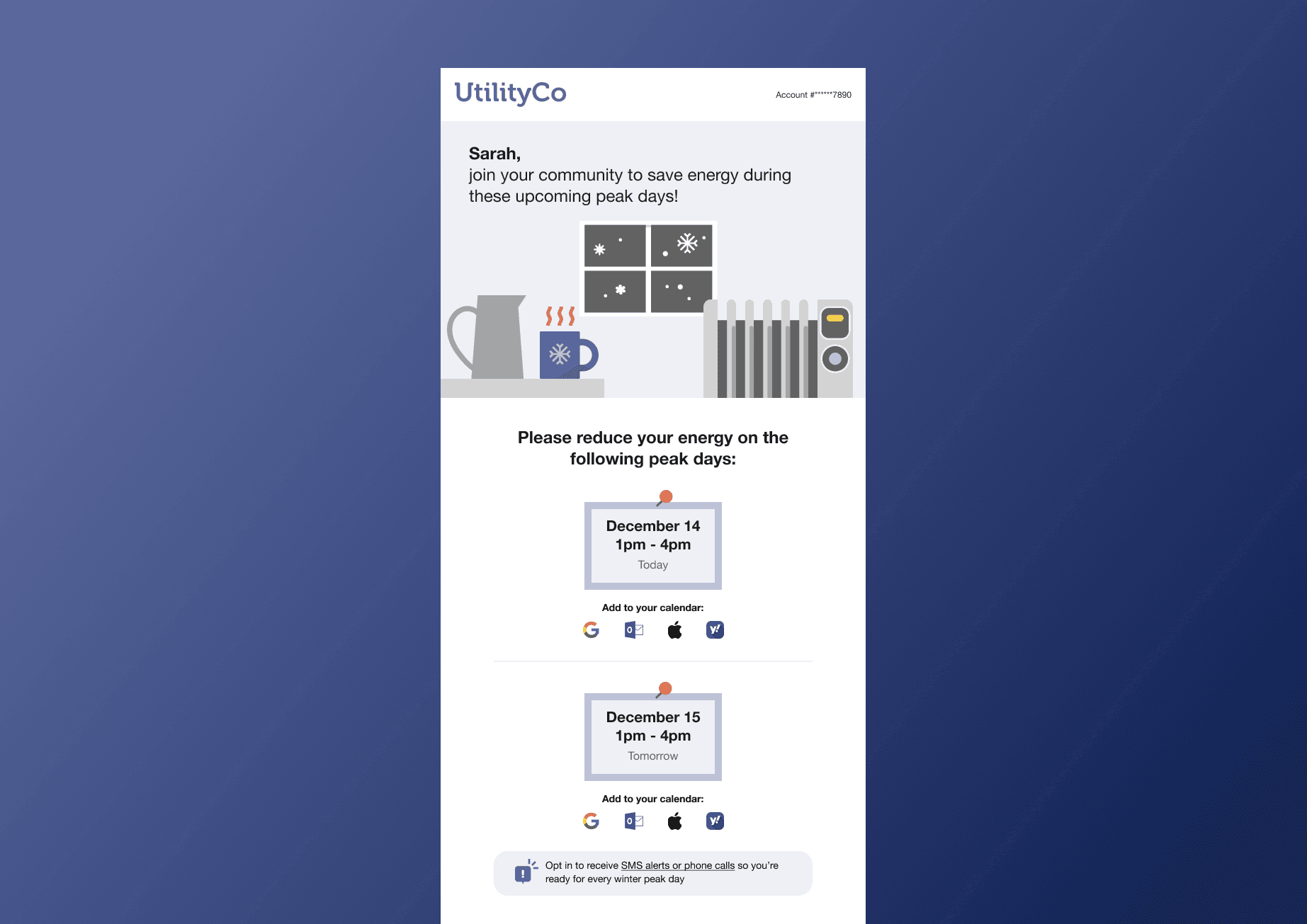
Event reminder email with calendar integration
DESIGN INTENT
Peak-day success depends on timing, not just intention
Calendar integration reduces reliance on memory and increases follow-through
Clear time windows lower cognitive load and prevent last-minute confusion
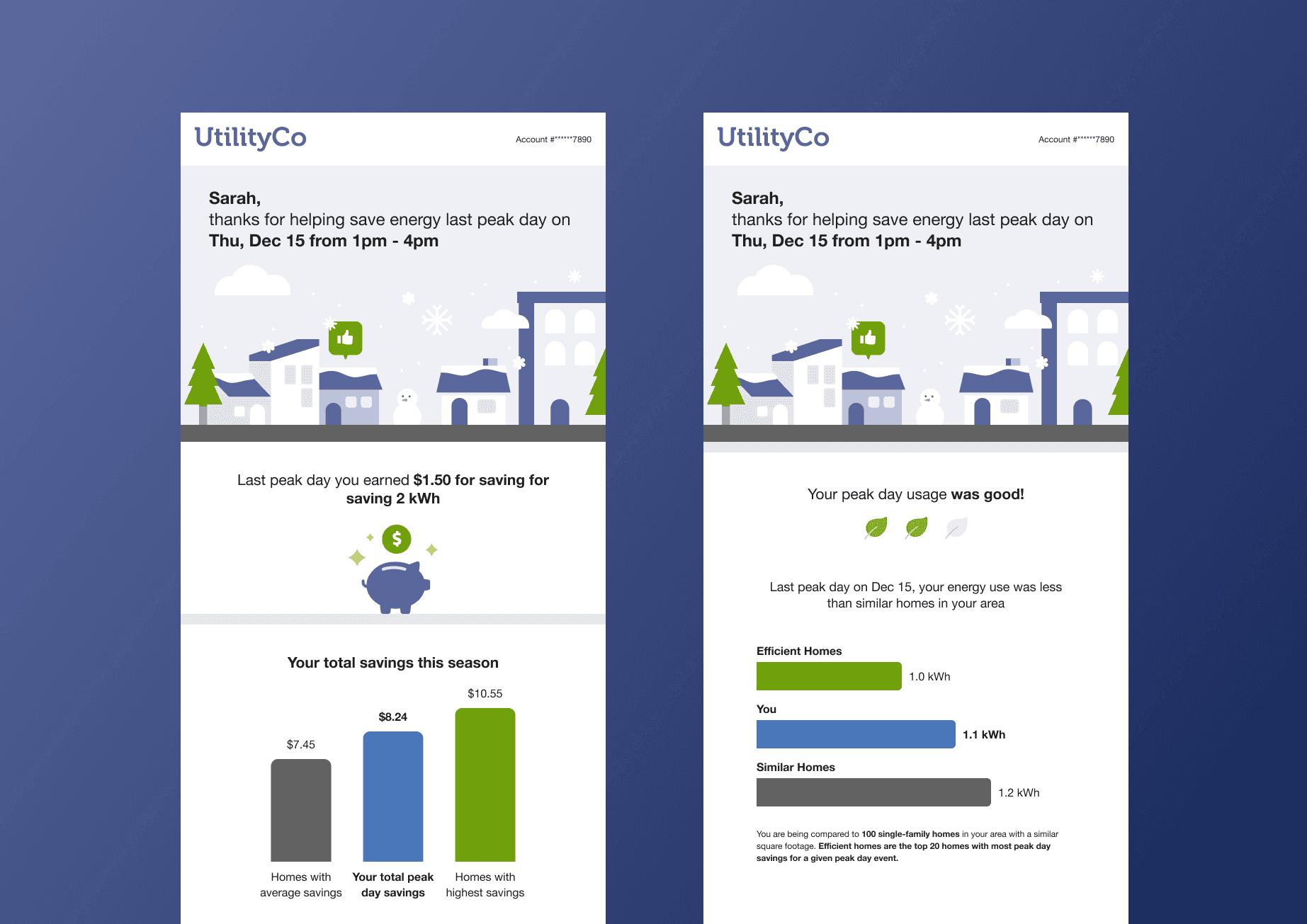
Post-event main insight (3-Bar Comparison)
DESIGN INTENT
Preserves motivation without introducing shame or rank anxiety
Makes performance differences immediately interpretable
Reinforces trust by grounding feedback in familiar benchmarks
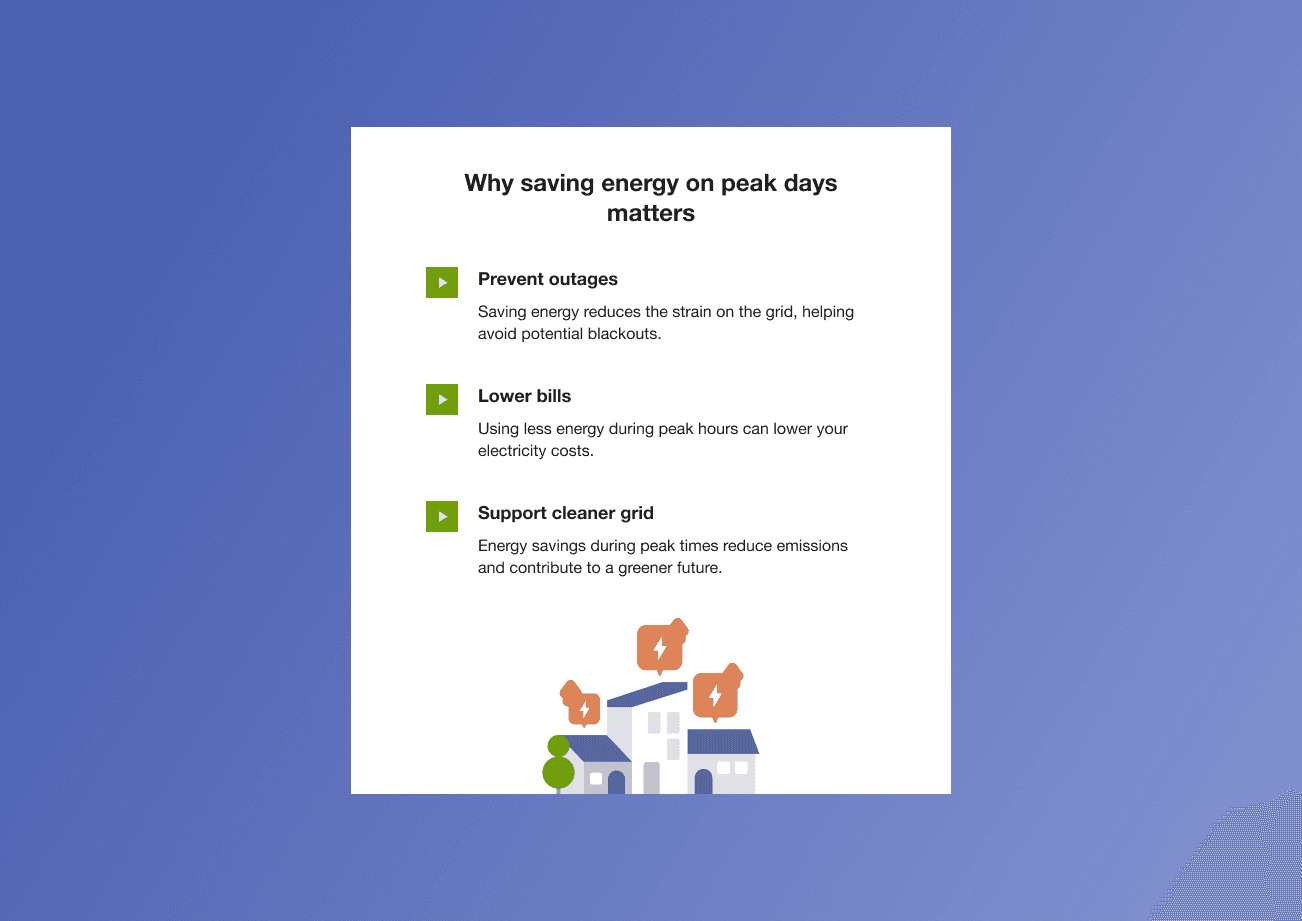
“Why this matters” module
DESIGN INTENT
To support long-term engagement, we paired performance feedback with lightweight education, in turn helping customers understand why peak-day participation matters beyond a single event.
Preserves motivation without introducing shame or rank anxiety
Makes performance differences immediately interpretable
Reinforces trust by grounding feedback in familiar benchmarks
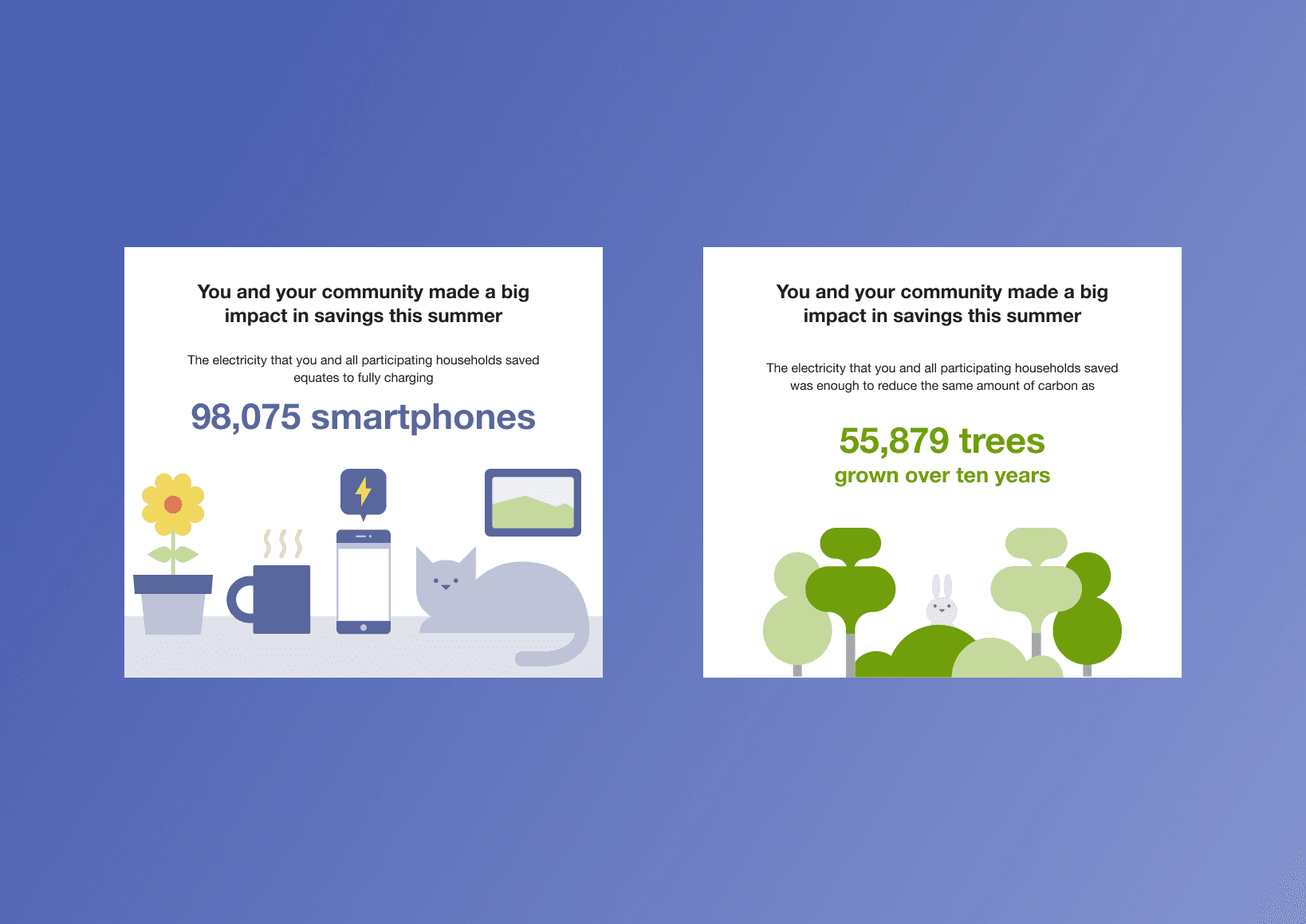
"Impact" modules with population-adaptive framing
DESIGN INTENT
Impact was framed using metaphors that resonated with different customer populations.
For climate-motivated audiences, savings were translated into environmental impact (e.g., trees grown).
For more pragmatically motivated audiences, impact was expressed through everyday analogies (e.g., smartphones charged).
This allowed the same underlying savings to feel relevant across diverse values without fragmenting the core experience.
OUTCOMES
Within the first few months of rollout:
The validated 3-Bar Comparison outperformed the legacy rank-based insight in ~95% of peak events, measured by energy savings outcomes
Clients adopted the new insight as the default across both BDR and PTR programs
The design became a foundation for expanding the peak-day experience across before, and after event touch points
Beyond performance lift, this work helped shift internal decision-making toward clear hypotheses, measurable outcomes, and behavioral evidence, even in cases where historical data was incomplete or noisy.
REFLECTIONS
I learned that clarity is not neutral. The way performance is framed can either motivate participation or quietly erode trust. Even when rank-based comparisons improved performance metrics, qualitative feedback revealed lingering doubt around why results differed, particularly in cases where customers suspected vacation homes or atypical usage patterns.
Designing for millions of households required balancing:
Behavioral effectiveness
Perceived fairness
Interpretability under real-world skepticism
Leading this work also pushed me into a more cross-functional role: initiating quantitative testing, aligning with analytics and delivery teams, and translating behavioral science into patterns engineers could reliably implement.
Most importantly, I learned how to advocate for design decisions using evidence, not taste and how to move complex systems forward without sacrificing customer trust.